Read Time: 8 min
Turbochargers are central to how modern diesel engines, off-highway equipment, and industrial generator sets hit power and emissions targets without a corresponding jump in engine size. But a turbocharger only performs as well as the tubing and connections feeding it. Hot-side downpipes, cold-side charge tubes, transition adapters, and oil drain lines all take the same vibration, heat, and pressure cycling as the turbo itself — and when they’re built from generic elbows and universal couplers instead of tubing engineered for the application, they’re usually the first thing to fail.
At T-Lane Industries, tube bending, end forming — including expanding, reducing, Marmon flaring, beading, and notching — and certified MIG/TIG welding come together to solve exactly this problem: precision-bent tubing and formed transition adapters that route cleanly around a turbocharger, seal reliably under boost, and hold up to thousands of hours of thermal cycling.
This guide covers the turbo-adjacent tubing components most likely to fail when built from stock parts, what a properly engineered replacement looks like, and how to know when a job needs a custom fabrication partner rather than an off-the-shelf fix.
TL;DR / Quick Summary
Custom-bent, end-formed tubing around a turbocharger — hot-side downpipes, cold-side charge tubes, flanges, V-band connections, and oil drain lines — eliminates the boost leaks and vibration failures that come from forcing generic parts into a tight engine bay or equipment enclosure.
Key Takeaways:
- Precision Bending: CNC tube bending keeps hot-side and cold-side turbo tubing on-geometry, eliminating the forced alignment that leads to stress fractures at weld seams.
- End-Formed Adapters: Expanded, reduced, or tapered transitions bridge mismatched turbo, intercooler, and manifold diameters without the abrupt steps that restrict airflow.
- Durable Flanges: Stainless steel flanges cut and welded to the exact manifold or turbine bolt pattern resist the warping and gasket failures common with thin, stamped flanges under repeated heat cycling.
- Serviceable Connections: Bead-rolled tube ends and V-band connections give off-highway and generator-set equipment a secure, serviceable seal in high-vibration environments.
Why Turbo Plumbing Fails Before the Turbo Does
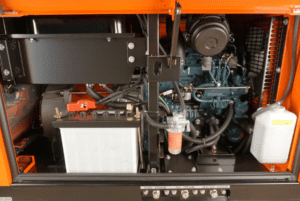
A turbocharger depends on a sealed, low-restriction path for exhaust gas in and compressed air out. Off-the-shelf elbows and universal silicone couplers are built to a generic diameter and angle, not to the exact routing of a specific engine bay or generator enclosure. When a technician has to force a stock part into alignment during installation, that part is pre-loaded with mechanical stress before the engine ever starts. Once operating temperatures push exhaust-side tubing toward 1,200°F–1,600°F, that stress compounds with thermal expansion, and something gives — usually a cracked weld seam, a blown gasket, or a split silicone coupler.
The same logic applies on the cold side. A compressor outlet that doesn’t match the intercooler piping diameter forces an abrupt step or an over-stretched coupler into the charge path, which restricts airflow and invites boost leaks exactly where they’re hardest to diagnose.
Where Custom Tube Fabrication Solves the Problem
Hot-Side Downpipes & Transition Flanges
Custom-bent downpipe tubing, paired with a flange cut and welded to match the turbine housing’s bolt pattern, replaces the guesswork of adapting a universal downpipe kit. Because the flange is fabricated to the actual mounting geometry rather than a generic bolt circle, it seats flat against the turbine housing without the forced alignment that leads to blown gaskets.
Cold-Side Charge Tubes & End-Formed Adapters
Where a compressor outlet and intercooler piping don’t share a diameter, an end-formed transition — a smoothly expanded or reduced cone rather than a stepped coupler — keeps airflow attached to the tube wall instead of creating turbulence that costs boost response. T-Lane’s end forming capabilities, including expanding, reducing, and specialty connections, are built for exactly this kind of transition work.
Precision-Cut Flanges
Flanges cut from heavier-gauge stainless plate and welded to the tube hold their sealing face flat through repeated heat cycles far better than thin, stamped factory flanges — the difference between a flange that needs re-torquing every few thousand hours and one that doesn’t.
V-Band and Bead-Rolled Connections
For equipment that needs to come apart for service — generator maintenance, off-highway equipment repairs — bead-rolled tube ends paired with V-band clamps give a positive, leak-free seal that doesn’t rely on hose clamps working loose under vibration.
Turbo Oil Drain Tubing
Oil drain lines are gravity-fed and unforgiving of tight bends or undersized diameter. A custom-bent drain tube, sized correctly and angled at a consistent downward slope, prevents the oil backup that pushes past turbine or compressor shaft seals — a failure mode that’s expensive to diagnose after the fact. If a legacy engine’s original drain fitting is no longer available, our reverse engineering process can reproduce it directly from the worn part.
What You Can Handle vs. When to Call a Professional
Tasks Most Equipment Operators Can Handle
- Bolt-On Component Assembly: Installing pre-fabricated V-band clamps, replacing gaskets, and mounting adapter plates that are already sized correctly.
- Routine Line Inspection: Checking couplers and clamps for cracking, wear, or loosening during scheduled maintenance.
- Basic Piping Mockups: Using cardboard or scrap tubing to check clearance and routing before ordering a custom component.
Tasks for Confident In-House Technicians
- Straight Tube Replacement: Swapping a damaged straight run of factory-spec tubing for an identical replacement using standard couplings.
- Minor Bracket Realignment: Adjusting isolation mounts to reduce vibration transfer before it reaches rigid tubing.
Tasks Requiring Professional Fabrication
- Custom Flange Fabrication: Cutting and welding flanges to match a specific turbine or manifold bolt pattern.
- Precision Tube Bending & End Forming: Producing hot-side or cold-side tubing with the exact bend geometry and transition diameters an installation requires.
- Certified TIG Welding: Joining stainless or aluminum tubing exposed to high vibration and thermal cycling without introducing weld porosity or cracking.
- Red flags requiring immediate professional attention: soot tracking around a flange joint, a glowing or discolored flange during normal operation, or oil visibly leaking from a drain line fitting.
Common Mistakes to Avoid
1. Using Thin Carbon Steel Flanges on High-EGT Systems
What people do wrong: Installing thin, stamped carbon steel flanges on engines running high exhaust gas temperatures.
Why it’s a problem: Carbon steel oxidizes and bows unevenly under heat, burning out gaskets every few thousand hours.
The right approach: Specify 304 or 409 stainless steel flanges cut to the actual mounting geometry, sized to hold flat through repeated heat cycles.
2. Over-Relying on Silicone Couplers Near the Turbo
What people do wrong: Running long silicone hose sections close to the hot side of the turbocharger.
Why it’s a problem: Radiated heat degrades silicone over time, leading to swelling, cracking, and boost leaks.
The right approach: Replace long hose runs with rigid, custom-bent metal tubing joined by welded flanges or V-band connections.
3. Undersized or Poorly Angled Oil Drain Lines
What people do wrong: Using an undersized drain line or routing it with a shallow-angle bend near the turbo center housing.
Why it’s a problem: Restrictive geometry causes oil to back up into the center housing and leak past shaft seals.
The right approach: Use a properly sized, smooth-bend drain tube angled consistently downward toward the oil pan.
Conclusion
Most turbocharger failures that look like a bad turbo are actually a plumbing problem — a flange that never sealed flat, a coupler that couldn’t take the heat, or a drain line that was never sized right. Solving that starts with tubing and connections built to the actual equipment, not adapted from a universal kit.
At T-Lane Industries, we bring over 40 years of tube bending, end forming, and certified welding experience to custom projects for heavy-duty diesel, off-highway, and generator OEMs — including exhaust systems for generator distributors like Ford, Stadco, Fiat, Deutz, Honda, and Kubota. If you’re dealing with a recurring turbo plumbing failure or need a custom-fit component for a legacy engine, contact our team today to discuss your project.
Serving Port Royal, Mifflintown, Harrisburg, Camp Hill, Carlisle, and clients across the United States.
Frequently Asked Questions
What turbo-related components does T-Lane fabricate?
We custom-bend and weld hot-side downpipes, cold-side charge tubes, transition adapters, mounting flanges, V-band tube connections, and oil drain lines to match the exact geometry of your engine or equipment enclosure.
Why do stock exhaust flanges warp on turbocharged engines?
Standard stamped flanges are typically thin carbon steel, which oxidizes and expands unevenly under high exhaust gas temperatures, causing the sealing face to bow and gaskets to fail. Flanges cut from heavier stainless plate hold flat through more heat cycles.
Can custom tubing bridge a turbo outlet and intercooler that don’t match in diameter?
Yes. End forming — expanding or reducing a tube end into a smooth, gradual cone — creates a clean transition between mismatched diameters without the turbulence that a stepped coupler introduces.
What materials are best for turbo-adjacent tubing?
304, 316, and 409 stainless steel are common choices for hot-side flanges and tubing, given their resistance to oxidation and thermal fatigue. Aluminized steel is a lower-cost option for moderate-temperature applications.
How can custom fabrication prevent turbo oil drain backup?
A properly sized drain tube, custom-bent to maintain a consistent downward slope with no tight low-side bends, keeps oil flowing to the pan instead of backing up into the center housing.
Related Resources
Sources
U.S. Environmental Protection Agency (EPA) — Heavy-duty diesel engine regulations and emissions compliance standards.
SAE — Engineering standards for turbocharger performance testing, flange mounting geometries, and high-temperature alloy specifications.
Occupational Safety and Health Administration (OSHA) — Industrial machinery safety, high-temperature exhaust piping containment, and ventilation standards (29 CFR 1910).


