Read Time: 8 min
Getting custom metal parts, structural tubing, or specialized OEM fabrications manufactured should not feel like an uphill battle. For procurement managers, design engineers, and field superintendents, the initial intake phase often becomes a major bottleneck. Incomplete engineering drawings, ambiguous material specifications, or missing tolerance callouts can stall RFQ (Request for Quote) evaluations and delay project initiation.
At T-Lane Industries, we believe that understanding how to order custom fabrication should be straightforward, transparent, and efficient. Streamlining the custom parts request process eliminates unnecessary back-and-forth, speeds up production scheduling, and ensures your finished parts arrive exactly to spec. Whether you need prototype tube bending, heavy structural weldments, or custom replacement components, establishing a clean intake workflow is the single best way to protect your project timeline.
This comprehensive guide outlines the exact information required for a seamless custom parts request, how our engineering team evaluates your files, expected project lead times, and practical strategies to optimize your fabrication budget.
TL;DR / Quick Summary
Navigating the custom parts request process requires clear documentation, proper CAD files, and precise material specifications to ensure an efficient evaluation and accurate pricing.
Key Takeaways:
- Submit both 3D CAD files (.STEP/.IGES) and 2D dimensioned prints (.PDF) for the fastest design review.
- Specify exact material grades, critical tolerances, and required surface finishes upfront.
- Engineering Design for Manufacturability (DFM) reviews help lower unit costs before production begins.
- Standard production lead times for custom fabrication orders generally range from 4 to 6 weeks.
The Essential Custom Parts Request Process
A successful custom fabrication project relies on clear communication between your engineering team and our fabrication specialists. Following a structured submission process prevents misinterpretation and guarantees that your technical requirements are met on the first run.
Custom Parts Request Process
| Step Number |
Phase |
| 1 |
Package Documentation |
| 2 |
Submit RFQ |
| 3 |
DFM Engineering Review |
| 4 |
Proposal & Sign-off |
| 5 |
Production & Quality QA |
1. Assembling Your Technical Drawing Package
Before submitting a request, gather all relevant engineering files and project parameters. Providing a complete file package allows automated laser nesting and CNC tube bending software to process geometry efficiently.
- 3D CAD Models (.STEP, .STP, .IGES): 3D solid models are essential for automated cutting, forming, and machining path calculations.
- 2D Dimensioned Drawings (.PDF, .DWG): 2D prints communicate critical details that 3D models omit, such as GD&T (Geometric Dimensioning and Tolerancing), thread pitches, weld symbols, and surface roughness requirements.
- Bill of Materials (BOM): For multi-component weldments or tubular assemblies, include a structured BOM detailing part quantities, hardware inserts, and sub-assembly hierarchies.
2. Specifying Material and Performance Requirements
Material selection directly impacts tool wear, forming limits, welding procedures, and overall project cost. Always specify the exact material grade rather than generic metal terms.
- Carbon Steel: Specify structural grades such as ASTM A36 plate, A513 mechanical tubing, or A500 structural tubing.
- Aluminum Alloys: Common choices include 6061-T6 for structural strength or 5052-H32 for superior sheet metal formability.
- Stainless Steel: Choose 304 for general industrial corrosion resistance or 316 for marine and chemical processing environments.
- Specialty Alloys: Note any high-yield, wear-resistant, or abrasion-resistant grades like AR400 or Domex.
3. Defining Quantities, Batch Sizes, and Schedule
Volume drives manufacturing strategy. A single prototype part requires individual setup and manual handling, whereas a production run of 500 units allows us to optimize CNC tooling paths and staging. Indicate whether your request is a one-time prototype, a repeating batch order, or an annual blanket purchase order with scheduled release dates.
Engineering Review & Design for Manufacturability (DFM)
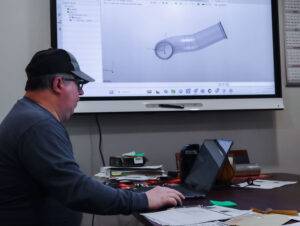
Once your RFQ package arrives, our engineering team performs a thorough Design for Manufacturability (DFM) review. DFM is the process of inspecting part geometry to ensure it can be manufactured efficiently without sacrificing structural integrity.
What Engineers Look for During Intake
During the intake review, T-Lane engineers evaluate several key parameters:
- Standard Tooling Alignment: Verifying that tube bend radii match standard die sizes (e.g., 1.5D or 2D center-line radius) to avoid custom tooling surcharges.
- Material Yield Optimization: Arranging tube cut lengths and nesting orders to maximize raw stock utilization and minimize scrap waste.
- Bend Relief & Port Clearance: Ensuring holes, ports, and weld bosses are placed far enough from bend zones to prevent material distortion during CNC tube bending.
- Weld Joint Accessibility: Confirming that certified welders have adequate torch clearance to perform clean MIG or TIG welds according to AWS standards.
In our experience across 40 years of custom tube bending and metal fabrication, early DFM feedback is a very effective way to eliminate costly design revisions after raw materials have already been ordered. Read more about how T-Lane’s custom fabrication process works here.
What You Can Handle vs. When to Partner with T-Lane
Understanding where internal field adjustments end and professional shop fabrication begins helps keep project budgets under control and maintains job site safety.
Tasks Internal Maintenance Crews Can Handle
- Basic Dimensional Measurement: Taking field measurements, center-to-center hole distances, and pipe outer diameters using calipers or measuring tapes.
- Minor Component Replacement: Installing pre-fabricated bracketry, replacing standard hardware, and bolting together modular structural frames.
- Surface Cleaning & Inspection: Removing rust, grime, or scale to prepare existing structural members for dimensional assessment.
Tasks for Confident In-House Technicians
- Simple Straight Cuts & Deburring: Trimming non-critical structural angle or unbent tubing to length using band saws or cold saws.
- Basic Tack Welding: Positioning temporary fit-up brackets on low-stress assemblies prior to final certified welding.
When to Engage T-Lane Industries
- Precision CNC Tube Bending: Tight-radius, multi-axis tube bending where wall thinning, wrinkling, or ovality must be strictly controlled.
- Structural & Pressure Weldments: Load-bearing assemblies requiring AWS-certified welding and non-destructive testing (NDT).
- High-Tolerance Machining & Endforming: Critical mating parts requiring ±0.005″ tolerances, flanged tube ends, or custom expansion/reduction profiles.
- Custom Tubular Assemblies: Complex multi-bend tubular components designed for heavy equipment, automotive, or industrial machinery.
Common Custom Fabrication Request Mistakes to Avoid

Avoiding standard intake errors speeds up quoting and ensures accurate pricing from day one.
1. Submitting 2D PDFs Without 3D CAD Files
What people do wrong: Sending only a PDF print and asking for a custom fabrication quote.
Why it’s a problem: Estimators must manually re-create part geometry in CAD software to calculate flat patterns, nesting efficiency, and machine runtime, adding unnecessary delay to the quoting evaluation.
The right approach: Always attach a 3D .STEP or .IGES file alongside your 2D PDF print.
2. Over-Specifying Tight Tolerances
What people do wrong: Applying a default Title Block tolerance of ±0.005″ across an entire heavy plate weldment or unmachined structural tube frame.
Why it’s a problem: Ultra-tight tolerances require secondary machining operations, specialized fixturing, and slow feed rates, which dramatically increase unit costs without adding functional value.
The right approach: Apply tight tolerances only to critical mounting surfaces, bearing journals, and mating interfaces; use standard commercial tolerances (±0.030″) for general structural features.
3. Omitting Coating and Finishing Specifications
What people do wrong: Requesting a quote for “custom steel brackets” without specifying whether the parts should be shipped raw mill finish, primed, powder coated, or hot-dip galvanized.
Why it’s a problem: Secondary finishing processes require specific surface preparation (such as sandblasting), hanging hole provisions, and secondary freight logistics. Omitting finish details leads to price revisions later.
The right approach: Explicitly state finish requirements on your drawing and RFQ form, including powder coat color codes or ASTM galvanizing standards.
Conclusion
Mastering how to order custom fabrication comes down to thorough prep work, clear technical documentation, and partnering with an experienced shop that prioritizes communication. By providing 3D CAD models, complete 2D drawings, exact material grades, and clear delivery expectations, you eliminate intake friction and set your project up for on-time, within-budget completion.
At T-Lane Industries, we bring over 40 years of precision tube bending, certified welding, and custom metal fabrication expertise to every job. Our engineering team is ready to review your files, perform a comprehensive DFM assessment, and deliver high-quality custom components tailored to your exact operational requirements.
Ready to submit your custom parts request? Contact us today to request a free quote.
Serving Port Royal, Mifflintown, Harrisburg, Camp Hill, Carlisle, and clients across the United States.
Frequently Asked Questions
What file formats are preferred for custom fabrication quotes?
We prefer 3D solid models in .STEP, .STP, or .IGES format paired with 2D drawings in .PDF format. For flat pattern or plate components, 2D vector files in .DXF or .DWG format are also highly acceptable.
What is Design for Manufacturability (DFM) and why is it important?
Design for Manufacturability is an engineering review process where we evaluate your part design against real-world shop tooling and machinery. DFM identifies opportunities to adjust bend radii, simplify weld access, or optimize material layout, ultimately lowering manufacturing costs and improving part quality.
What standard lead times should I expect for custom fabrication orders?
Standard production lead times for custom fabrication orders generally range from 4 to 6 weeks depending on job complexity, material availability, and finishing requirements. Rush services and expedited production schedules are available for emergency maintenance or critical project scenarios.
Why are 3D CAD files required alongside 2D drawings?
While 2D drawings communicate critical tolerances, threads, and finish requirements, 3D CAD files allow automated software to calculate exact material weights, flat pattern layouts, and machining paths, resulting in faster and more accurate quote evaluations.
What’s the difference between ordering a prototype and a production run?
A prototype requires individual setup and manual handling, which carries a higher per-unit cost since tooling isn’t yet optimized for volume. A production run of 500 or more units lets us program CNC tooling paths once and repeat them efficiently, lowering the cost per part. Share your expected volume upfront so we can quote accordingly.
Does T-Lane accept blanket purchase orders for recurring parts?
Yes. For parts you order on a recurring basis, we can set up an annual blanket purchase order with scheduled release dates, so you lock in pricing and lead time without resubmitting a full RFQ every time.
Related Resources
Sources
American Welding Society (AWS) D1.1 Structural Welding Code — Industry standard guidelines for steel welding qualifications and quality assurance.
ASME Y14.5 Geometric Dimensioning and Tolerancing Standard — Link to the authoritative engineering guideline providing uniform rules, definitions, and 14 geometric symbols for Geometric Dimensioning and Tolerancing (GD&T)


