Read Time: 8 min
Custom metal fabrication is the backbone of modern industrial manufacturing, but a design is only as reliable as the material from which it is built. Whether engineering a high-pressure hydraulic line, a heavy-duty truck exhaust system, or a structural frame for an industrial OEM, material selection is the critical pivot point where theoretical engineering meets real-world performance. Selecting the wrong alloy can lead to catastrophic field failures, premature corrosion, structural fatigue, or unnecessary cost overruns.
At T-Lane Industries, we have spent over 40 years refining the art and science of welding and custom fabrication services. We understand that material selection is not a secondary detail; it is the very foundation of fabrication excellence. This guide breaks down the core metals used in custom fabrication, their unique properties, and how to choose the right material for your next project.
TL;DR / Quick Summary
Choosing the correct metal alloy based on environmental exposure, temperature, mechanical load, and weight is essential to ensuring the structural integrity and cost-efficiency of custom-fabricated components.
Key Takeaways:
- Stainless Steel offers unmatched corrosion resistance and thermal stability for harsh environments and exhaust systems.
- Carbon Steel provides maximum structural strength and cost-effectiveness for heavy-duty industrial frames.
- Aluminum delivers high strength-to-weight ratios and natural oxidation resistance for weight-sensitive applications.
- Precision Fabrication requires adjusting CNC bending and welding parameters to match each alloy’s unique physical properties.
The Core Metallurgy: Comparing Key Fabrication Materials
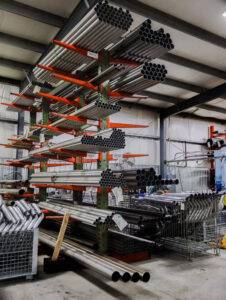
Different industrial applications demand distinct physical and chemical properties. Matching the correct metal to its operating environment, mechanical stresses, and manufacturing processes ensures long-term durability and optimal performance.
Stainless Steel: The Champion of Corrosion Resistance
Stainless steel is defined by its chromium content (minimum 10.5%), which reacts with oxygen to form an invisible, self-healing passive layer of chromium oxide. This layer prevents surface corrosion and rust.
- Grade 304: The industry standard. It features excellent formability, weldability, and general corrosion resistance. It is ideal for structural components, brackets, and general tubular products.
- Grade 316: Contains 2% to 3% molybdenum, which dramatically increases resistance to chlorides (saltwater, de-icing chemicals) and industrial acids. It is essential for marine, chemical processing, and highly corrosive environments.
- Grade 409/439: Ferritic grades with lower chromium and minimal nickel. They are highly stable under thermal cycling, making them the gold standard for automotive and heavy-duty truck exhaust systems.
Carbon Steel: The Backbone of Structural Strength
Carbon steel is valued for its exceptional tensile strength, malleability, and cost-effectiveness. It is categorized by its carbon content, which dictates its hardness and weldability.
- Mild Steel (Low Carbon, e.g., 1010, 1020): Highly ductile and easy to bend, machine, and weld. It is the most common material for structural tubing, brackets, and general machinery frames.
- Medium/High Carbon Steel: Offers significantly higher strength and wear resistance but requires specialized heat treatment and welding procedures to prevent cracking.
Aluminum: Lightweight and Highly Formable
At roughly one-third the weight of steel, aluminum is the material of choice when weight reduction is critical to performance, fuel efficiency, or ease of handling.
- 5052 Aluminum: Highly workable, excellent corrosion resistance (especially in marine environments), and highly weldable.
- 6061 Aluminum: A structural alloy that can be precipitation-hardened. It offers excellent strength-to-weight ratios and is widely used in extruded shapes and structural tubing.
Specialty Alloys: Engineered for Extremes
When standard metals fail under extreme heat, pressure, or chemical attack, specialty alloys step in.
- Inconel & Hastelloy: Nickel-chromium-based superalloys that retain high tensile strength and oxidation resistance at temperatures exceeding 1,500°F.
- Titanium: Offers strength comparable to steel at roughly 60% of the weight, alongside unmatched chemical resistance.
Key Factors Influencing Material Selection

Choosing between steel, aluminum, and stainless fabrication requires a balanced evaluation of several operational and environmental variables. When consulting with our clients, we evaluate the following critical
factors:
-
Operating Environment & Corrosion Risk
Will the component be exposed to moisture, salt spray, road chemicals, or harsh industrial acids?
- High Exposure: Grade 316 Stainless Steel or marine-grade 5052 Aluminum are required to prevent premature oxidation.
- Controlled/Indoor Environments: Mild carbon steel is highly cost-effective, provided it is finished with a protective layer such as powder coating, zinc plating, or wet paint.
-
Temperature Extremes
Metals expand, contract, and lose strength when subjected to extreme thermal cycles.
- Exhaust & Combustion: Standard carbon steel will rapidly scale and degrade under exhaust temperatures. Ferritic stainless steels (409/439) or austenitic grades (321) are required to withstand thermal expansion without cracking.
- Cryogenic/Low Temp: Some carbon steels become brittle at sub-zero temperatures, whereas stainless steel and aluminum maintain their ductility and toughness.
-
Mechanical Stress and Structural Load
The component must withstand static, dynamic, or high-pressure loads without permanent deformation (yielding) or cracking (fatigue).
- High-Pressure Hydraulics: Requires seamless, high-strength carbon steel tubing with precise wall thicknesses to prevent bursting.
- Structural Support: Heavy-duty frames rely on structural carbon steel or high-strength aluminum alloys to distribute loads safely.
-
Weight Constraints
In the transportation, automotive, and heavy-duty truck sectors, every ounce saved translates directly to fuel efficiency, payload capacity, and reduced wear on suspension components.
- Weight-Sensitive Applications: Aluminum is the clear winner, offering excellent structural integrity at a fraction of the weight of steel.
-
Budget and Total Cost of Ownership (TCO)
While raw material cost is an important factor, smart procurement managers look at the Total Cost of Ownership.
- Upfront vs. Lifecycle Cost: Mild carbon steel has a lower initial material cost but requires ongoing maintenance, painting, or replacement. Stainless steel or aluminum may have a higher upfront cost, but eliminate maintenance and replacement cycles, saving thousands of dollars over the product’s lifecycle.
Common Material Selection Mistakes to Avoid
-
Over-Specifying Materials
- What people do wrong: Choosing high-grade alloys like 316 stainless steel or Inconel for applications where mild carbon steel or 304 stainless steel would perform perfectly.
- Why it’s a problem: It dramatically inflates material costs and machining times without adding functional value to the end product.
- The right approach: Analyze the actual chemical and thermal exposure of the application. Use specialty alloys only where standard grades fail to meet safety or longevity thresholds.
-
Ignoring Material “Springback” in Design
- What people do wrong: Designing tight-tolerance tubular parts without accounting for how different metals spring back after bending.
- Why it’s a problem: It leads to dimensional inaccuracies, assembly alignment issues, and high scrap rates during production.
- The right approach: Work with an experienced fabricator who utilizes CNC bending machines programmed with precise material-specific springback profiles.
-
Underestimating Galvanic Corrosion
- What people do wrong: Fastening or welding dissimilar metals (like aluminum and carbon steel) directly together in wet or humid environments.
- Why it’s a problem: The electrical contact between different metals accelerates corrosion at the joint, leading to rapid structural failure.
- The right approach: Use non-conductive isolators, gaskets, or select compatible alloys to prevent galvanic reactions.
The T-Lane Advantage: Precision Fabrication Meets Material Expertise

Understanding metallurgy is only half the battle; the material must also be highly manufacturable. Different metals behave uniquely under mechanical stress, heat, and cutting forces. At T-Lane Industries, our state-of-the-art facility in Port Royal, Pennsylvania, is engineered to handle the unique challenges of diverse materials:
- CNC Tube Bending: Different metals have different rates of springback. Our advanced CNC tube bending machines are programmed with precise material profiles, ensuring that whether we are bending ductile aluminum, rigid carbon steel, or work-hardening stainless steel, the final angles and centerline radii are perfectly accurate to your OEM specifications.
- Precision Welding (TIG & MIG): Welding stainless steel requires precise shielding gas control to prevent “sugar” (oxidation on the backside of the weld), while welding aluminum requires high heat input to break through the material’s natural oxide layer. Our highly skilled, certified welders possess decades of experience in cross-material welding, ensuring structurally sound, aesthetically clean joints.
- Endforming and Machining: From expanding and reducing tube diameters to flaring, beading, and slotting, we understand how different alloys flow under pressure, preventing material thinning or cracking during the endforming process.
Since starting in 1984, our history of manufacturing excellence has been built on a customer-centric approach that prioritizes quality, precision, and on-time delivery for every client across North America.
Conclusion
Material selection is a complex decision that directly impacts your product’s performance, lifespan, and manufacturing cost. By partnering with an experienced fabricator early in the design phase, you can optimize your material choices, streamline production, and eliminate costly engineering revisions down the road.
Since 1984, T-Lane Industries has been a trusted partner for industrial OEMs, automotive suppliers, and commercial enterprises across North America. We don’t just bend metal; we provide comprehensive, collaborative engineering support to ensure your custom tubular components and weldments are built to perform and built to last.
Ready to optimize your material selection and streamline your fabrication process?
Please contact our team today at +1 (717) 527-2856 or email [email protected] to discuss your project specifications, request a quote, or explore our advanced CNC fabrication capabilities.
Serving Port Royal, Mifflintown, Harrisburg, Camp Hill, Carlisle, and clients across the United States.
Frequently Asked Questions
What is the difference between 304 and 316 stainless steel in fabrication?
The primary difference is that 316 stainless steel contains 2% to 3% molybdenum, whereas 304 does not. This addition makes 316 significantly more resistant to pitting and corrosion in chloride-rich environments, such as marine applications or chemical processing plants. For general-purpose indoor or outdoor structural use, 304 stainless steel is highly durable and more cost-effective.
Why is aluminum harder to weld than carbon steel?
Aluminum has a high thermal conductivity and a low melting point compared to steel, meaning heat dissipates rapidly away from the weld zone. Additionally, aluminum naturally forms a tough surface layer of aluminum oxide, which melts at a much higher temperature (approx. 3,700°F) than the aluminum itself (approx. 1,200°F). Welders must use specialized AC TIG or pulsed MIG setups to break through this oxide layer without burning through the base metal.
What is “springback” in CNC tube bending, and why does it matter?
Springback is the tendency of a metal tube to slightly unbend or return to its original shape after the bending pressure is released. The amount of springback varies by material; for instance, stainless steel springbacks significantly more than mild carbon steel. Fabricators must over-bend the tube by a precise, calculated angle so that the final relaxed state matches the exact blueprint specifications.
Can mild steel be used outdoors without coating?
No. Mild carbon steel contains very little corrosion-resistant alloying elements. If left raw and exposed to outdoor moisture and oxygen, it will begin to rust almost immediately. To use mild steel outdoors, it must be protected with a high-quality surface finish such as hot-dip galvanizing, industrial powder coating, or specialized epoxy paint.
How does wall thickness affect tube bending limits?
Wall thickness directly dictates the structural stability of a tube during the bending process. Thin-walled tubes are highly susceptible to wrinkling on the inside of the bend or collapsing/flattening on the outside of the bend. Bending thin-walled tubing requires specialized internal mandrels and wiper dies to support the material shape, whereas thick-walled tubing is much more structurally stable during deformation.
Sources


